
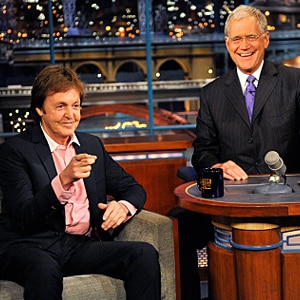
 David Letterman: Our first guest made his American television
debut on this stage in 1964 launching the British invasion with a band called “The
Beatles”. Since then, he’s won 13 Grammy Awards and become the most successful
composer in the history of popular music. He will be performing at City Field,
home of the New York Mets, at July 17th, 18th and 21st.
Please welcome the great Paul McCartney! Paul.
David Letterman: Our first guest made his American television
debut on this stage in 1964 launching the British invasion with a band called “The
Beatles”. Since then, he’s won 13 Grammy Awards and become the most successful
composer in the history of popular music. He will be performing at City Field,
home of the New York Mets, at July 17th, 18th and 21st.
Please welcome the great Paul McCartney! Paul.
-
Thank
you.
-
How
you doing?
-
Good.
Thank you.
-
Good
to see ya.
-
Yeah.
It’s good to be here. Cool. Oh my.
-
You
know, you’re one of the people obviously that we’ve tried to get on the program
as a guest about every week maybe every other day. We would call and find out
“can he be on the show? Can he be on the show?” And after the first 15 years we
started to get our feelings hurt. And now it’s been close to 25-30 years and I
just need to know, going forward, any problems we don’t know about?
-
I
don’t like the show.
-
Well,
ok. We’ll make a note of that. We’ll put that in your file: “By the way, Sir
Paul doesn’t care for the show.”
-
What
can I tell you?
-
Good
to have you here, though. I know you’ve been in this building since 1964, I
think you did an MTV up close.
-
Yeah,
I did something here.
-
But
when you… does it mean anything to you to walk back into this building?
-
Yeah.
It really does, actually. I was just thinking today when we first came here,
we’d never seen this kind of thing. TV studios in England were kind of all in
one floor. The make-up was next door to this and next… but here it’s like an
apartment block.
-
Right.
-
You
know, you go to make-up then you take an elevator, 5 floors, then you go to
wardrobe then you come here. But yeah, just the memory of being here, it was
great, it was kinda scary the first time.
-
I
would think so.
-
Yeah.
-
How
long had the band been together? How old was the band when you came to this
country to do this show?
-
How
old was the band? I don’t know. I think about 6 months. No, no, no. I’m just
being silly! No, no, no. It was very old. It was an old band. We were, I don’t
know, like, 8, 9 years old, or something.
I don’t count. People know my history much better than I do.
-
So
you. But you were 22, is that about right?
-
Yeah.
-
And
the band came together. You and John became buddies and then you joined his
band. Was that the beginning of it?
-
Yeah.
-
And
then George was a friend of yours.
-
George
was my buddy, yeah.
-
And
then you guys joined and then Ringo came.
-
Yeah.
-
But
you really hadn’t been, I mean, like crazy maniacal successful very long when
you came to this country.
-
No,
it was kinda nice, we got popular, like, in Liverpool and we played Hamburg,
kinda got popular there. Went back to Liverpool and they thought we were from
Germany. Great memories. We said: “you know, we were very popular two months
ago!” And then, you know, we did very well in England and then finally we came
here, which was sort of where we wanted to do well.
-
I
remember as a kid we would look for anything we could find out about the
Beatles and we would go to the library in High School and check out a Time
magazine that had an article about you and the band and everybody was crazed
with anticipation for the arrival. And your family? Musical background? Your
father was a musician?
-
My
dad was… well, he was a cotton salesman really but he did play the piano at
home and he had a little jazz band when he was in his twenties. He told me they
weren’t really that good. I used to love his piano playing, I think that’s
where I got it from, how I love music. They went out as the… what was it? “The
Masked Players”.
-
Masked
Players?
-
But
that’s because they had been there as another name and got fired so they came
back with masks on.
-
You
have to do what you need to do to get a gig.
-
Resourceful
there.
-
Can
you… tell us about yourself and then tell us about the other guys in the band.
-
Well,
I’m a boy. I like girls.
-
When
you came in to do the show, 22 year-old kid. What kind of a kid were you then?
-
Well,
you know, I mean…that’s… when you say… my memories… I don’t know where you find that but when we
were 22 I thought we were like, older that I feel now. Because, you know, we
were smoking Peter Stuyversant and cigarettes, and we thought we
were like, really grown up. We were only 22, so… But I had to stand somewhere
here and there was a curtain and… the audience was out there and we were in a
kind of a very neutral America, loving it but a little bit scared, and I had to
do Yesterday, my song, on my own and I’d never done this, I’d always have the
band with me, but suddenly they said: “you’re doing Yesterday”, so I said:
“ok”. So I’m standing there: “come on, get it together, it’s ok”, and the floor
manager, the guy on the curtains came up to me and said: “you nervous?” I said
“no”, he said: “you should be, there’s 73 million people watching”.
-
Wow!
Well, sadly, you won’t have that problem tonight.
-
Why?
How many we got tonight? What’s the figures tonight?
-
Look
at this, here we are, talk about kids… oh my goodness… there they are. How was
Ringo thought of in those days? Were you guys nice to Ringo?
-
Sometimes…
sometimes, you know... he was a good boy. He had had a beard that would had to
go. But he looks rather good, doesn’t he?
-
I
remember reading, as I said, we tried to find out everything we could about the
Beatles, that Ringo was sickly as a child, was that true?
-
At
that age, really true, yeah, and that’s not funny cause he got peritonitis when
he was 3 and that’s like… you can die of that, it’s a stomach thing. And the
first thing we ever knew of it, cause you know… we wouldn’t talk about that
kinda stuff… was when we were in Miami and we were all in a swimming pool
together, I think it was for the cover of Life magazine, you know, magazine
dropping.
-
I
see…
-
And
he had a rather high costume, swimming costume, trunks. And we all had them all
swelled on, speedo, jobs, and we kinda ended up asking about and it turned out
that he had scars on his stomach from that peritonitis thing. So he was very
lucky to be here, you know.
-
And
was the chemistry… Were you all four friends, were two of you friends, three of
you friends, one loner? How did that work? Did it change… the dynamic?
-
It
changed a little bit from time to time, yeah. We were very good friends, I knew
George from where I lived, so we were kinda friends in that kinda way. I knew
John cause I joined the band and he was a friend of a mate of mine. And then
Ringo came later, so, you know, he was not the sort of guy we knew that well
but we soon got to know each other. I mean, we just went in so many vans lying
on top of each other you have to kind of…
-
Yeah,
to me, my impression of it, not that my impression counts for anything other
than my impression, but it was four guys on a very very long Spring break.
-
Yeah.
-
Just
like the best time four guys could ever had.
-
Well,
it certainly seemed like that. You know, yeah. It was definitely a great thing.
I say because we sort of got popular in Liverpool, England... by the time we
came here, we were ready for it. So, you know, we went down on Spring break, we
went down to Miami, the British car firm loaned us an MG each and you know,
there was beach and sand and girls and… come on!
-
Yeah,
come on!
(Part 2)
Seems about right, doesn’t it? Toward the end of the 60’s is that when
the rumors about you being dead surfaced? Do you remember that? Do you remember
how that started? What were your feelings about that?
-
What
happened… yeah, my feelings. Yeah, no,
what happened was we did a cover for a record called “Abbey Road”. See? Even
the cover gets applause. So, yeah, the idea was to walk across the crossing and
I showed up that day with sandals, flip flops, and so… it was so hot that I
kicked them off and walked across barefooted so this started some rumor that
“because he was barefooted, he’s dead!” I couldn’t see the connection myself.
-
Seems
like a long, slow, difficult death. Being barefooted will kill ya!
-
Scorch
feet.
-
And
how do you manage something like that, because it was a global rumor.
-
I
mean, you know, I just laughed at it and knew it was just because of the fame
and the craziness. It was American DJs, so you guys are to blame. Not you
personally but… now the thing is, I just laughed it off but it was a little bit
strange, the people did start to look at me like… “is it? Is it him or a very
good double?”
-
Well,
that was the idea. That was the other part of it that there was a guy who
looked like you taking your place.
-
Well,
this is him.
-
Yeah…
or is it?... Tell us what this photograph brings to mind, this was taken in
1982, you worked with Michael Jackson on… was it “Thriller”? You did songs for
that album?
-
Yeah.
-
What
do you remember of that experience?
-
Oh,
it was great, you know. We had a great time. It was Christmas and I was at home
and my phone rang and a little voice, you know, talked to me and I said “who’s
this?”, like kinda guarding my privacy private number. “Who’s this?” “It’s
Michael.” “Michael WHO?” I thought it was, you know, a little bit sort of dodgy,
but anyway, he said “Michael Jackson” he said, “so, do you wanna make some
hits?” So I said “yeah, sure”. You know, being of the hit making variety. So…
we did, and it was really nice. You know, he came to my house and got to know
the family and stuff and he had a great guy who used to come with him, a guy
called Billy. So, it was very nice we had a really good time, we made a couple
of records together, did a video, and we were very good friends. It actually kinda
fell apart a little bit later because he was talking to me and asking my
business advice and one of the things I said to him was “think about getting
into music publishing” and then he looked at me kinda of, I thought he was
joking, he says “I’m gonna get yours.”
-
Oh,
yeah.
-
So,
you know, I kind of thought… oh, you! You go! But
it turned out to be true. Which was, you know, it was cool, somebody had to get
it, I suppose. But… what happened next is then I started to ring him up, cause
I thought, ok, he is the guy historically placed to give Lennon-McCartney a
good deal, at last. Cause we were signed when we were 21 or something in a back
alley in Liverpool and the deal, it’s remained the same even though we made
this company the most famous… hugely successful. So, I kept thinking “it was
time for a raise!” you know. Well, you would, you know?
-
Yes,
I think so.
-
So,
it was great but I did talk to him about it but he kinda blanked me on it. He
kept saying “that’s just business, Paul, you know.” So, yeah, it is... then
waited for a reply. But we never kind of got to it, and I thought… hum… so, we
kind of drifted apart. It was no big bus stop… we kind of drifted apart after
that.
-
Ok,
I tell you what…
-
But
he was a lovely man, massively talented and we miss him.
-
We’ll
be right back here. Oh, wait a minute, wait a minute, what are we doing? What
happened? I’m sorry, I was…
-
Not
reading your cards….
We’re having too much fun, though.
-
Now
Paul, when we come back, you’ve played inside the Ed Sullivan Theater and now
we’re gonna ask you to go up on to the marquee… reasonably safe. And I’m
guessing in your long career of performing
you have appeared on a marquee somewhere, right?
-
I’ve
done a roof
-
Ok,
close enough. So, we’ll be right back with Paul McCartney on the marquee.

David Letterman: Nosso
primeiro convidado estreou na televisão americana neste palco, em 1964,
marcando o início da invasão britânica com uma banda chamada “The Beatles”.
Desde então, ganhou 13 prêmios Grammy e tornou-se o compositor mais bem
sucedido da história da música popular. Ele se apresentará no ginásio dos New
York Mets, City Field, em 17, 18 e 21 de Julho. Por favor, recebam o grande
Paul McCartney! Paul.
-
Obrigado.
-
Como vai?
-
Bem, obrigado.
-
É muito bom vê-lo.
-
É bom estar aqui. Muito bom. Nossa.
-
Sabe de uma coisa, você é um dos artistas que
vínhamos tentando trazer para o programa quase toda semana. Ligávamos para
perguntar “ele pode vir até o programa? Ele pode?” E depois de 15 anos
começamos a ficar magoados. Agora já se passaram 25, 30 anos e eu preciso saber
antes de continuarmos, tem algum problema que eu precise saber?
-
Eu não gosto do programa.
-
Tudo bem. Vamos tomar nota. Colocaremos no seu
arquivo: “Sir Paul não é fã do programa.”
-
Fazer o quê, né?
-
Mas é um prazer recebê-lo. Eu sei que você esteve
neste prédio em 1964, acho que pra um especial da MTV.
-
Eu fiz alguma coisa do gênero.
-
E quando você... significa alguma coisa pra você
estar de volta a esse prédio?
-
Na verdade, sim. Eu pensei nisso hoje. Quando
viemos da primeira vez, nunca tínhamos visto nada desse tipo. Os estúdios de TV
de Londres eram todos em um único andar. A maquiagem era do lado disso e
daquilo... mas aqui é como se fosse um condomínio.
-
Verdade.
-
É assim, você passa na maquiagem, pega um
elevador, sobre 5 andares pra chegar no camarim e só então chega até aqui. Mas,
é, a lembrança de já ter estado aqui, e foi ótimo mas foi meio assustador da
primeira vez.
-
Imagino que tenha sido.
-
E foi.
-
A banda estava junta há quanto tempo? Quantos
anos a banda tinha quando você veio pra cá fazer esse show?
-
Quanto tempo tinha a banda? Eu não sei. Acho que
uns 6 meses. Não, não, não. Estou brincando! Não, não, não. Era bem velha. Já
era uma banda velha, de 8 ou 9 anos, eu acho. Eu não fico contando. As pessoas
sabem da minha história muito melhor do que eu.
-
Mas você tinha 22 anos, certo?
-
Sim.
-
E a banda foi formada. Você e John se tornaram
amigos e depois você entrou na banda. Foi assim que tudo começou?
-
Foi.
-
George era seu amigo.
-
Era meu camarada, sim.
-
Então vocês se juntaram e depois veio o Ringo.
-
Sim.
-
Mas vocês não eram loucamente bem sucedidos há
muito quando vieram pra cá.
-
Não. Foi bem legal. Ficamos famosos em Liverpool
e depois tocamos em Hamburgo e ficamos meio populares por lá. Voltamos a
Liverpool e as pessoas acharam que éramos alemães. Ótima memória a deles.
Dissemos: “nós éramos super famosos dois meses atrás!” Depois, nos demos muito
bem na Inglaterra e finalmente viemos pra cá, que era justamente onde queríamos
mesmo nos dar bem.
-
Eu me lembro de quando era menor, a garotada
procurava saber tudo sobre os Beatles, íamos até a biblioteca da escola pra
olharmos a revista Time que tinha um artigo sobre você e a banda e todo mundo
ficava louco de ansiedade esperando a vinda de vocês. E a sua família? E sua
bagagem musical? Seu pai era músico?
-
Meu pai era... na verdade, ele era um vendedor
de algodão mas ele tocava piano em casa e tinha uma bandinha de jazz quando
tinha uns 20 anos. Ele me disse que a banda não era muito boa mas eu adorava
quando ele tocava piano. Acho que foi daí que adquiri amor pela música. Eles se
apresentavam como... como era mesmo? “Os Mascarados”.
-
Mascarados?
-
É porque eles tinham se apresentado com outro
nome mas foram demitidos, então voltaram com máscaras nos rostos.
-
Você tem que fazer o que for necessário pra
conseguir um emprego.
-
Tem que ser engenhoso.
-
Fale um pouco de você e dos caras da banda.
-
Bem, eu sou um garoto. Eu gosto de garotas.
-
Quando você veio pra cá se apresentar, um garoto
de 22 anos. Que tipo de garoto você era?
-
Bem, sabe... é disso que eu falo... minha
memória... não sei da onde isso vem mas quando tínhamos 22 anos, eu achava que
éramos mais velhos do que eu sou hoje. Porque, você sabe, fumávamos Maria Joana e cigarros e a gente
achava que era adulto de verdade mas só tínhamos 22 anos. Mas eu tinha que
ficar parado aqui no palco e tinha uma cortina... a platéia ficava na minha
frente, era uma América bem neutra, eu estava amando mas também com um pouco de
medo. E eu tinha que cantar Yesterday, minha música, sozinho e eu nunca tinha
feito isso. Sempre tinha a banda comigo mas de repente eles me disseram: “você
vai cantar Yesterday” e eu disse: “ok”. Daí eu fiquei parado ali na frente:
“vamos lá, se concentre, tá tudo bem” e o diretor de palco, o cara atrás das
cortinas, chega pra mim e diz: “tá nervoso?” eu disse: “não”, ele disse: “pois
devia, tem 73 milhões de pessoas assistindo”.
-
Uau! Bem, infelizmente, você não ter esse
problema hoje.
-
Por que? Quantas estão vendo hoje? Qual é a
estatística pra hoje?
-
Olha isso, veja só, e por falar em garotos... ô
meu Deus... aqui estão eles. Como vocês viam o Ringo nessa época? Vocês eram
legais com ele?
-
Às vezes... às vezes... você sabe... ele
era um menino bom. Ele tinha barba que precisava sair de cena. Mas ele tá
bonito, não tá?
-
Eu me lembro de ter lido, como eu disse, a gente
tentava descobrir tudo que fosse possível sobre os Beatles, que o Ringo era
doentinho quando criança. É verdade?
-
Nessa idade, era verdade, sim e isso não tem
graça porque ele teve peritonite aos 3 anos de idade e tipo... é perigoso
morrer disso, é uma coisa de estômago. A primeira coisa que ficamos sabendo
sobre isso, porque assim... sabe como é... não conversávamos sobre esse tipo de
coisa... foi quando fomos pra Miami e estávamos todos juntos numa piscina, acho
que era pra capa da revista Life, sabe, de cair o queixo!
-
Sei como é...
-
Ele tava com um calção bem na cintura, uma roupa
de banho, shorts. E nós estávamos só de sunga, então acabamos perguntando pra
ele o porquê da roupa toda e o fato era que ele tinha cicatrizes na barriga por
causa da peritonite. Então ele teve muita sorte de ter conseguido chegar até
aqui, sabe?
-
Como era a química entre vocês... vocês eram
todos amigos? Alguns eram mais ou menos amigos? Como é que funcionava? Mudava
um pouco... a dinâmica?
-
Mudava de tempo em tempo, sim. Éramos bons
amigos. Eu conheci o George da vizinhança onde morávamos então tínhamos isso em
comum. Conheci John através de um amigo meu e porque entrei pra banda. Depois o
Ringo se juntou a nós, então, a gente não conhecia ele muito bem no começo mas
logo depois ficamos todos nos conhecendo. É que viajamos juntos em tantas vãs
abarrotadas, dormindo uns por cima dos outros, que não tinha outro jeito...
-
É, pra mim, na minha opinião, não que minha
opinião sirva pra alguma coisa além de ser minha opinião. É que vocês eram 4
garotos em longas férias de primavera.
-
Sim.
-
A maior farra que 4 garotos podiam fazer.
-
Com certeza a gente sentia isso mesmo. Foi muito
legal. Como ficamos famosos em Liverpool, Inglaterra... quando finalmente
viemos pra América, já estávamos prontos pra isso tudo. Então, você sabe, nas
férias de primavera, fomos pra Miami. Uma companhia britânica nos emprestou
carros MG, um pra cada e aí, sabe como é, praia, areia, garotas... você sabe!
-
Sim, eu sei!

(Part 2)
É isso mesmo, não
é? Foi mais ou menos no fim dos anos 60 que os boatos sobre a sua morte
surgiram? Lembra disso? Lembra de como isso começou? O que você achou disso?
-
O que aconteceu... o que eu achei disso. É, não.
O que aconteceu foi que fizemos uma capa pra um disco chamado “Abbey Road”. Tá
vendo? Até a capa ganha aplauso. Pois então, a ideia era atravessar a faixa de
pedestres e eu apareci usando chinelos, sandálias... tava tão quente que eu
chutei eles e saí andando descalço e isso começou um boato que “se está
descalço, está morto”! Eu particularmente não entendi o que uma coisa tinha a
ver com a outra.
-
Parece uma maneira demorada, lenta e difícil de
morrer. Andar descalço mata!
-
Queimadura nos pés.
-
E como você lida com uma coisa dessas, porque
foi um boato global.
-
Sei lá, eu dei risada e sabia que era tudo por
causa da fama e da loucura. Foram DJs americanos que começaram então a culpa é
de vocês. Não você propriamente mas... o que aconteceu foi isso e eu dei risada
mas era meio estranho, as pessoas ficavam mesmo me olhando tipo... “é ele mesmo
ou um dublê muito bom?”
-
Mas essa era a ideia. A outra parte da história
era que tinha um cara exatamente igual a você que estaria tomando seu lugar.
-
Bem, aqui está ele.
-
Sim... ou será que não?... Conte o que vem à sua
mente ao ver esta fotografia. Ela foi tirada em 1982, você trabalhou com
Michael Jackson... foi no Thriller? Você compôs músicas pra esse álbum?
-
Foi.
-
O que você se lembra dessa experiência?
-
Foi ótima, sabe... A gente se divertiu bastante.
Era época de Natal e eu tava em casa aí meu telefone tocou e uma vozinha, sabe,
falou comigo e eu disse: “quem é?”, aí respondi tipo guardando a santidade do
meu número privado. “Quem tá falando?” “É o Michael”. “QUE Michael?” Eu achei
meio suspeito, mas de qualquer forma, ele respondeu “Michael Jackson”, ele
disse, “então, quer compor uns sucessos?” E eu respondi “claro, com certeza”.
Logo eu, um cara compositor de sucessos. Então... fomos compor e foi muito
legal. Sabe, ele veio até a minha casa e conheceu minha família e tudo e ele
trouxe um cara muito legal chamado Billy. Foi muito bom e divertido, gravamos
uns dois álbuns, fizemos um videoclipe e ficamos muito amigos. Na verdade, só
desandou depois de um certo tempo porque ele tava falando comigo e me pedindo
conselho sobre negócios e uma das coisas que eu disse a ele foi “considere o
meio de edição musical” daí ele olhou pra mim tipo, eu achei que ele tava
brincando, aí ele disse “vou pegar suas músicas”.
-
Sei.
-
Mas aí, você sabe, eu pensei... ah vai nada. Vai
lá! Mas aí acabou sendo verdade. Mas também, tava beleza, sabe, alguém tinha
que fazer isso, eu acho. Mas... daí depois eu tentei ligar pra ele, porque eu
pensei, ok, se existe uma pessoa historicamente posicionada para um bom negócio
com Lennon-McCartney, tem que ser ele. Porque assim, a gente assinou contrato
quando tínhamos 21 anos num beco em Liverpool e o acordo continuou o mesmo
desde então, apesar termos tornado essa empresa a mais famosa... um sucesso
gigante. Então eu pensei, “tá na hora de um aumento!” Você sabe, né?
-
Acho que sim.
-
Foi tudo bem mas eu cheguei a falar com ele e
ele meio que me deu um chega pra lá. Ele só dizia “são só negócios, Paul, você
sabe.” Então foi assim... eu esperei uma resposta dele. Mas nunca chegamos a
resolver isso e eu pensei... hum... então nos distanciamos. Não teve briga...
só nos distanciamos depois disso.
-
Ok, deixa eu te falar...
-
Mas ele era um homem adorável e incrivelmente
talentoso que deixou saudades.
-
Voltamos em instantes. Espera aí, espera aí, o
que vamos fazer? O que aconteceu? Me desculpe, eu não...
-
Não leu suas anotações...
É porque estamos
nos divertindo demais.
-
Paul, quando voltarmos, você já tocou no teatro
Ed Sullivan e agora vamos te pedir pra subir na marquise... é mais ou menos
seguro. Acredito que durante a sua longa carreira de apresentações, você deva
ter subido em alguma marquise, certo?
-
Já toquei num telhado.
-
Ok, é quase a mesma coisa. Então, quando
voltarmos, Paul McCartney vai subir na marquise.


Nenhum comentário:
Postar um comentário